Smarter Business Solutions Guide: Your Roadmap for 2025 Success
Imagine your business not just keeping pace, but actually thriving as 2025 brings new challenges and opportunities. The business world is shifting rapidly, and adapting is no longer optional.
AI, automation, and data-driven insights are transforming how organizations compete. Companies that move quickly to embrace these tools are seeing real gains.
Leveraging smarter business solutions is the key to unlocking growth, efficiency, and resilience in this evolving landscape.
This guide will show you proven strategies and actionable steps to position your business for success in 2025.
We will cover the changing business environment, essential technologies, process optimization, team empowerment, and how to measure your progress. Let’s chart your path to a smarter, stronger future.
Understanding the 2025 Business Landscape
Adapting to the future requires more than just keeping pace with change. Businesses in 2025 must rethink their approach, making smarter business solutions central to their strategy. With technology evolving rapidly and customer expectations rising, understanding the landscape is the first step to staying competitive.

Major Trends Shaping 2025
The business world in 2025 is driven by a surge in digital transformation. Organizations have accelerated their adoption of smarter business solutions, using technology to streamline operations and respond to market shifts.
One of the most significant trends is the mainstream adoption of AI and automation. According to recent studies, AI adoption in retail will reach 80% by year-end, making it clear that smarter business solutions are no longer optional but essential for survival.
Remote and hybrid work models have become standard, transforming how teams collaborate and interact. This shift demands flexible digital infrastructure and new management approaches.
Sustainability and ESG compliance are now at the forefront, with businesses expected to demonstrate responsible practices. Customers are demanding personalized, instant service and omnichannel experiences, pushing companies to invest in smarter business solutions that can deliver on these expectations.
Global competition is fiercer than ever, especially from digital-first startups. As a result, cybersecurity and data privacy have risen to the top of every organization’s priority list.
Key Challenges Businesses Face
Despite the opportunities, organizations face several hurdles in adopting smarter business solutions. Economic uncertainty and market volatility create pressure to make careful, strategic investments.
Talent shortages and the need for continuous upskilling are ongoing concerns. Companies must integrate new technologies with legacy systems, often requiring significant resources and expertise.
Managing the costs and measuring the ROI of digital transformation can be daunting. Regulatory pressures and compliance requirements add another layer of complexity, particularly in industries handling sensitive data.
Maintaining agility in decision-making is vital. Rapid change can lead to decision fatigue, making it harder for leadership to act quickly and with confidence. These challenges highlight why smarter business solutions must be flexible, scalable, and aligned with long-term goals.
Opportunities for Growth
Amid these challenges, there are clear opportunities for businesses ready to leverage smarter business solutions. Data analytics enables smarter decision-making, uncovering trends and insights that drive performance.
Expanding into new markets is now more accessible via digital channels. Companies can reach global audiences with tailored offerings and agile marketing tactics.
Building resilient supply chains is another growth area. Technology-driven logistics and real-time monitoring reduce risks and improve efficiency.
Enhancing customer experience through smarter business solutions increases loyalty and retention. Personalized interactions, faster service, and seamless omnichannel support set leaders apart from the competition. By focusing on these opportunities, organizations can position themselves for sustainable growth and lasting success.
Building Your Smarter Solutions Strategy for 2025
Developing a robust strategy for smarter business solutions is essential for navigating the challenges and opportunities of 2025. By following a structured approach, organizations can position themselves for growth, adaptability, and long-term success.

Assessing Your Current State
Start your journey toward smarter business solutions by evaluating where your organization stands today. Begin with a digital maturity audit to gauge your current technology landscape and identify outdated systems. Look for process inefficiencies and bottlenecks that slow down operations or impact customer satisfaction.
Benchmark your performance against industry leaders. Use metrics like digital adoption, automation rates, and customer engagement to see how you compare. This honest assessment helps identify gaps and opportunities, laying the foundation for future initiatives.
Setting Strategic Goals
Once you understand your current position, set clear strategic goals for adopting smarter business solutions. Align technology investments with your core business objectives. Define measurable KPIs such as cost reduction, revenue growth, or customer experience improvements.
Prioritize your initiatives based on their expected impact and feasibility. Focus on projects that deliver the highest value while considering available resources and timelines. This approach ensures your efforts drive meaningful progress toward transformation.
Selecting the Right Technologies
Choosing technologies is central to smarter business solutions. Evaluate options like AI, automation, and cloud platforms for their ability to integrate with your existing tools and support scalability. Consider vendors with strong track records and robust support.
Platforms such as Empowering Businesses with AI Tools offer curated solutions, expert guidance, and comparisons to help you make informed technology decisions. Investing in the right tools will future-proof your operations and enable seamless digital transformation.
Change Management Essentials
Implementing smarter business solutions requires effective change management. Communicate your vision and the benefits of digital initiatives to all stakeholders early in the process. Develop a clear roadmap for phased implementation so teams understand what to expect.
Address resistance by fostering a culture of innovation and providing necessary training. Encourage feedback and celebrate quick wins to keep momentum high. Successful change management ensures that new technologies are adopted smoothly and deliver their intended value.
Risk Management and Compliance
A sound smarter business solutions strategy must include comprehensive risk management. Assess cybersecurity risks regularly to protect sensitive data and maintain operations. Ensure compliance with data privacy regulations relevant to your industry and region.
Develop contingency and disaster recovery plans. This proactive mindset minimizes downtime and helps your business respond quickly to unexpected challenges. Staying vigilant in these areas safeguards both your reputation and your bottom line.
Example: How a mid-sized retailer transformed operations by adopting cloud-based inventory management and AI-powered customer support, resulting in a 20% reduction in costs.
A mid-sized retailer illustrates the power of smarter business solutions in action. By implementing a cloud-based inventory management system, the company gained real-time visibility into stock levels and streamlined order fulfillment.
At the same time, deploying AI-powered customer support enabled faster response times and personalized service. Together, these changes led to a 20% reduction in operational costs, demonstrating the tangible benefits of a well-executed strategy.
Leveraging AI, Automation, and Digital Tools
Adopting smarter business solutions is crucial for thriving in the rapidly changing landscape of 2025. As digital innovation accelerates, businesses must leverage the latest AI, automation, and digital tools to stay competitive. These technologies are no longer optional, but essential for growth, efficiency, and resilience.
The Role of AI in Business Success
Artificial intelligence is at the core of smarter business solutions. AI-driven analytics empower leaders to make data-backed decisions, improving forecasting and uncovering growth opportunities.
Chatbots and virtual assistants offer 24/7 support, handling routine customer inquiries and freeing staff for higher-value tasks. Automated marketing tools personalize outreach, ensuring each customer receives timely, relevant communication.
Personalization engines, powered by AI, help businesses tailor products and services to individual preferences. This not only boosts customer satisfaction, but also strengthens brand loyalty.
By embedding AI into daily operations, companies can unlock new efficiencies and drive smarter business solutions across every department.
Automation for Efficiency
Automation transforms how organizations operate by streamlining repetitive or manual tasks. Robotic Process Automation (RPA) is a prime example, automating processes in finance, HR, and supply chain management.
Consider a manufacturing firm that implements automation in its order processing. Tasks that once required hours of manual input can now be completed in minutes, reducing errors and increasing throughput.
Automated workflows in areas like invoicing, scheduling, and data entry minimize human intervention and accelerate turnaround times. This shift allows teams to focus on strategy and innovation, a hallmark of smarter business solutions.
Choosing the Right Digital Tools
Selecting digital tools is a foundational step in building smarter business solutions. Prioritize usability, integration capabilities, and potential return on investment when evaluating options.
Cloud-based platforms offer flexibility and scalability, ensuring your business can adapt as needs evolve. Project management applications, CRM systems, and collaboration suites are indispensable for modern teams.
Here’s a quick comparison:
| Tool Type | Key Benefit | Example Use Case |
|---|---|---|
| Project Management | Task Coordination | Team workflow tracking |
| CRM | Customer Insights | Sales pipeline management |
| Collaboration Suite | Remote Teamwork | Real-time document sharing |
By choosing the right technology stack, organizations can support smarter business solutions that boost productivity and performance.
ToolStacked: Empowering Businesses with AI and Automation Tools
ToolStacked is a trusted platform for organizations seeking to implement AI and automation as part of their smarter business solutions strategy. The platform provides expert recommendations, tool comparisons, and educational resources for decision-makers.
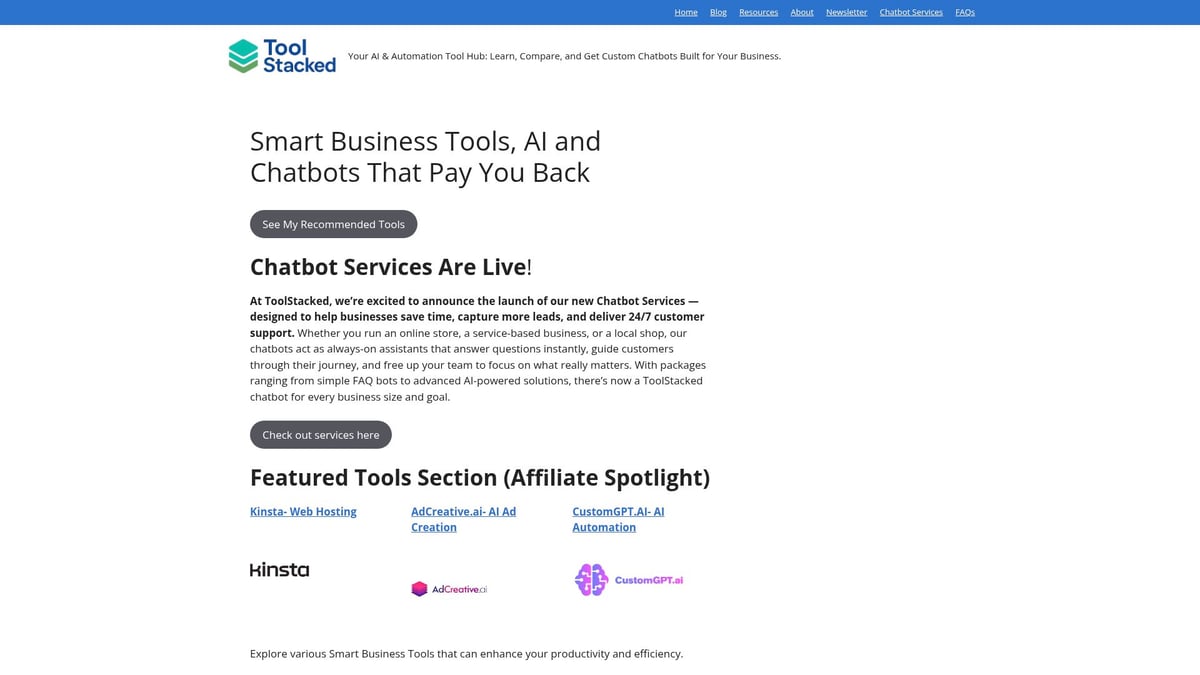
With ToolStacked, businesses can access custom chatbot development for lead capture and customer support, ensuring seamless integration into existing systems. The platform guides users in selecting the best tools for their unique needs, maximizing time savings and customer satisfaction.
Leveraging ToolStacked’s expertise helps organizations accelerate the adoption of smarter business solutions and achieve measurable ROI.
Measuring the Impact of AI and Automation
To realize the full benefits of smarter business solutions, it is essential to track and measure outcomes consistently. Start by monitoring productivity gains and cost savings after implementation.
Use real-time dashboards to visualize operational improvements and identify areas for further optimization. Track customer experience metrics, such as response times and satisfaction scores, to gauge the effectiveness of AI-powered support.
As business needs evolve, adapt and scale your smarter business solutions for sustained growth. Regular measurement ensures you stay on course and continue delivering value.
Optimizing Processes for Maximum Efficiency
Continuous process optimization is essential for companies seeking to lead with smarter business solutions. By focusing on workflow redesign, seamless digital integration, and a culture of ongoing improvement, businesses can unlock greater efficiency, agility, and cost savings.

Mapping and Redesigning Workflows
To maximize efficiency, organizations must map out current workflows and identify areas for improvement. This approach enables leaders to pinpoint bottlenecks and prioritize changes that deliver the highest impact. Applying smarter business solutions during workflow redesign can reveal hidden inefficiencies and streamline operations.
Key steps include:
- Documenting each stage of critical processes
- Analyzing task dependencies and redundancies
- Applying Lean or Six Sigma principles to reduce waste
Modern AI-powered tools, such as those discussed in the Review of Predis.ai for Business, can automate analysis, flag process gaps, and recommend optimizations. This empowers teams to make data-driven decisions, creating a foundation for ongoing success.
Digital Integration and Interoperability
Efficient operations depend on the seamless integration of digital systems. Smarter business solutions require connecting disparate platforms so data flows freely and accurately across departments. API-driven integrations enable companies to achieve interoperability without costly replacements.
Common integration challenges include:
- Data silos between legacy and new systems
- Compatibility issues with third-party applications
- Security and compliance considerations
By addressing these barriers, organizations can reduce manual work, minimize errors, and improve real-time visibility. Investing in integration enhances business agility and supports future scalability.
Continuous Improvement Culture
Embedding a continuous improvement culture is vital for sustaining smarter business solutions. Companies should encourage feedback from employees at all levels, using their insights to drive iterative enhancements. Regular process reviews and open communication channels foster innovation and adaptability.
Effective strategies include:
- Hosting process improvement workshops
- Recognizing and rewarding innovative ideas
- Utilizing data analytics to monitor progress
This approach creates an environment where teams feel empowered to suggest changes, leading to incremental gains that add up over time.
Performance Monitoring and Analytics
Real-time performance monitoring is a cornerstone of optimizing with smarter business solutions. Dashboards and analytics platforms provide leaders with immediate insights into process health and outcomes. Setting up alerts for deviations ensures quick responses to potential issues.
Key metrics to track:
| Metric | Purpose |
|---|---|
| Cycle time | Measure process speed |
| Error rates | Identify quality issues |
| Resource utilization | Optimize workforce allocation |
| Customer satisfaction | Assess service improvements |
With these analytics, businesses can continuously refine operations, uncover new opportunities, and align process changes with strategic goals.
Case Study: Logistics company leveraging IoT and analytics to optimize delivery routes, saving 15% on fuel costs.
A leading logistics provider sought smarter business solutions to cut operational costs and boost efficiency. By implementing IoT sensors on vehicles and advanced analytics, the company mapped optimal delivery routes in real time. This technology-driven transformation reduced fuel expenses by 15 percent, improved on-time deliveries, and enhanced customer satisfaction.
Such results highlight the tangible benefits of process optimization, demonstrating how smarter business solutions can drive measurable business value.
Empowering Teams for the Future of Work
Empowering teams is fundamental to implementing smarter business solutions. As the workplace evolves, businesses must focus on digital skills, foster collaboration, lead change with empathy, embrace inclusion, and prioritize well-being. These pillars ensure your workforce is ready for the challenges and opportunities of 2025.
Building Digital Skills and Capabilities
Developing digital skills is at the core of smarter business solutions. Begin by identifying skill gaps across your organization using regular assessments and feedback. Offer ongoing learning opportunities such as:
- E-learning platforms with interactive modules
- Microlearning for just-in-time knowledge
- Workshops focused on practical tech adoption
Rapid upskilling is now possible with tools that allow teams to build custom AI agents in minutes. For example, this Building Custom AI Agents Quickly guide demonstrates how businesses can empower employees to automate tasks without extensive coding knowledge. Investing in continuous development ensures teams remain relevant and agile.
Fostering a Collaborative Culture
Smarter business solutions thrive in environments where collaboration is seamless. Equip teams with digital tools for remote and hybrid work, such as cloud-based document sharing and real-time messaging platforms.
Encourage cross-functional teamwork by:
- Setting up virtual brainstorming sessions
- Rotating team members across projects
- Rewarding collective achievements
A company that integrated digital collaboration tools saw an 18 percent productivity boost, showcasing how the right solutions can transform teamwork. Prioritizing communication and accessibility is key for future-ready teams.
Change Leadership and Employee Engagement
Leading teams through digital transformation demands empathy and clear communication. Involve employees early in smarter business solutions initiatives to build trust and reduce resistance.
Recognize and reward innovative efforts, whether they come from frontline staff or management. Address challenges by:
- Hosting open forums for feedback
- Providing resources for digital adoption
- Offering one-on-one support for hesitant team members
Engaged employees are more likely to champion new technologies, driving successful transformation throughout your organization.
Diversity, Equity, and Inclusion in the Smart Workplace
Inclusive workplaces are essential for unlocking the full potential of smarter business solutions. Build diverse teams that bring varied perspectives to problem-solving and innovation.
Promote equity by:
- Ensuring access to training for all employees
- Adopting unbiased recruitment and promotion practices
- Designing technology that is accessible to everyone
Inclusive adoption of tech not only fosters creativity but also strengthens your organization’s reputation and resilience in the evolving business landscape.
Well-being and Work-Life Balance
Supporting employee well-being is integral to smarter business solutions. Use technology to offer flexible work arrangements, monitor workloads, and provide wellness resources.
Key initiatives include:
- Digital platforms for mental health support
- Automated reminders for breaks and self-care
- Analytics to identify early signs of burnout
Balancing productivity with well-being leads to sustained engagement and long-term success. Prioritizing a healthy work-life balance will help your teams adapt and thrive in the future of work.
Measuring Success and Scaling Smarter Solutions
Adopting smarter business solutions is only the beginning. Measuring their impact and scaling success across your organization requires a disciplined, data-driven approach. Leaders must define clear metrics, leverage analytics, and create processes that allow innovation to flourish while maintaining strategic focus.
Defining Success Metrics
To gauge the effectiveness of smarter business solutions, start by establishing clear, quantifiable KPIs. These might include productivity gains, cost reductions, customer satisfaction scores, or revenue growth. Align each metric with your strategic objectives to create a direct link between technology investments and business outcomes.
For digital transformation, measure both leading and lagging indicators. Leading indicators, such as employee adoption rates or process cycle times, provide early signals of progress. Lagging indicators, like ROI or market share, reveal the long-term impact of smarter business solutions.
A well-designed KPI framework enables ongoing evaluation and ensures that efforts remain focused on tangible business value. Regularly reviewing these metrics helps organizations adapt their smarter business solutions strategy as market conditions evolve.
Data-Driven Decision Making
Data-driven decision making is at the heart of smarter business solutions. Real-time analytics dashboards provide leaders with insights into operations, customer behavior, and emerging trends. By monitoring these analytics, companies can quickly identify opportunities and respond to challenges.
Predictive analytics tools use historical data to forecast future performance, enabling proactive strategy adjustments. For example, a retailer leveraging predictive analytics increased sales by 10 percent by anticipating customer demand and optimizing inventory. The surge in global AI adoption to surge 20% in 2025 underscores the urgency for businesses to adopt smarter business solutions or risk falling behind.
Integrating data from multiple sources enhances visibility and drives better decision making, turning information into a powerful competitive advantage.
Scaling Up: From Pilot to Enterprise-Wide Adoption
Once smarter business solutions prove effective in pilot projects, scaling them across the enterprise becomes the next challenge. Start by documenting lessons learned and identifying key success factors from your pilot. Build a scalable framework that includes standardized processes, governance structures, and cross-departmental alignment.
Ensure that all teams understand the benefits and are equipped with the necessary tools and training. Communicate wins and share best practices to maintain momentum as smarter business solutions are rolled out organization-wide.
A phased approach, with regular checkpoints and feedback loops, helps mitigate risks and ensures that scaling delivers consistent value across the business.
Overcoming Common Pitfalls
Scaling smarter business solutions is not without challenges. Avoid the temptation of “shiny object syndrome” by staying focused on solutions that directly support your strategic goals. Change fatigue can erode engagement, so pace initiatives appropriately and celebrate milestones along the way.
Solicit regular feedback from stakeholders and use it to refine your approach. Monitor adoption rates and address barriers swiftly to maintain progress. By learning from setbacks and adapting strategies, organizations can sustain the momentum of smarter business solutions and drive long-term success.
Future-Proofing Your Business
Future-proofing requires a commitment to continuous learning and innovation. Stay informed about emerging technologies and evolving market dynamics. Build partnerships with technology providers, industry peers, and educational institutions to strengthen your ecosystem.
Invest in ongoing training to keep your workforce prepared for future shifts. Foster a culture that encourages experimentation and embraces change, ensuring that smarter business solutions remain a core driver of resilience and growth.
Regularly revisit your strategies and metrics to ensure they align with new opportunities, enabling your business to thrive in a landscape defined by rapid transformation.