
Marketing Agency Lead Generation Guide: Winning Clients in 2026
In 2026, marketing agencies face more competition and higher client expectations than ever before. Are you prepared to stand out in a rapidly shifting landscape?
Digital transformation, artificial intelligence, and evolving client behaviors are rewriting the rules of marketing agency lead generation. Agencies that want to win and retain high-value clients must master innovative strategies and stay ahead of trends.
This guide offers a clear, step-by-step roadmap to help your agency generate quality leads and secure clients in 2026. We will explore the new lead generation landscape, how to build a winning strategy, leverage advanced tools, optimize inbound and outbound tactics, and measure success.
Understanding the 2026 Lead Generation Landscape
The landscape of marketing agency lead generation is rapidly transforming as agencies adapt to new technologies and evolving client demands. Staying ahead requires a deep understanding of these shifts, as well as a willingness to embrace change.
The evolution of lead generation for agencies
In recent years, marketing agency lead generation has moved from broad cold outreach to highly personalized, data-driven engagement. Agencies now rely on AI and automation to identify, qualify, and nurture prospects with precision. Omnichannel strategies that blend social, email, content, and conversational marketing have become standard. For example, agencies that adopted AI-powered prospecting in 2025 reported a 30 percent increase in qualified leads, highlighting the tangible benefits of embracing these new approaches.
Key challenges and opportunities
Agencies today face intense competition from both niche and global players. Clients expect measurable ROI and complete transparency, while privacy regulations limit traditional data collection. However, opportunities exist in underserved verticals and emerging markets. According to Lead Generation Statistics 2025, 68 percent of agencies cite client acquisition as their top challenge. Agencies that proactively address these challenges position themselves for growth in the ever-evolving marketing agency lead generation space.
Changing client expectations and behaviors
Clients increasingly seek agencies with specialized expertise and a clear value proposition. They value faster response times and proactive communication, expecting real-time reporting and AI-driven insights. Brands now prefer agencies that offer transparency and can adapt quickly to changing needs. This shift means that marketing agency lead generation efforts must focus on demonstrating expertise and delivering concrete results, not just promises.
The role of technology and AI
Technology is at the heart of modern marketing agency lead generation. AI chatbots qualify and nurture leads around the clock, while predictive analytics help agencies target high-intent prospects. Automation reduces repetitive tasks, freeing staff to focus on strategy and creative work. These advancements enable agencies to scale their lead generation efforts efficiently and stay competitive in a crowded market.
Data-driven decision making
Tracking every touchpoint in the lead journey is crucial for optimizing marketing agency lead generation. Agencies use analytics to refine targeting and messaging, ensuring resources are invested where they deliver the most impact. For instance, a case study showed that using multi-touch attribution increased conversion rates by 22 percent, proving the value of data-driven strategies in achieving measurable results.
Building a Winning Lead Generation Strategy for Agencies
To master marketing agency lead generation in 2026, agencies must develop a strategic, data-driven approach. Success begins with clarity about your audience, a strong value proposition, measurable goals, and a commitment to continuous improvement.

Defining your target audience and ideal client profile
The foundation of effective marketing agency lead generation is a precise understanding of your ideal clients. Start by building detailed buyer personas that identify industry, company size, pain points, and key decision-makers.
Use insights from market research, social listening, and your current client base to validate these personas. For example, an agency specializing in SaaS might target VC-funded startups seeking rapid growth and scalable solutions. By narrowing your focus, you improve targeting accuracy and make your outreach more relevant.
Crafting a compelling value proposition
Standing out in a crowded market requires a value proposition that is both unique and clear. Your agency's value should be easy for prospects to understand and directly address their business challenges.
Emphasize what makes your marketing agency lead generation approach different. For example, you may offer performance-based pricing, guaranteed lead quality, or proprietary AI-driven processes. Clearly communicate these differentiators across your website, proposals, and sales conversations to attract high-value clients.
Setting SMART goals and KPIs
A winning strategy is built on measurable objectives. Set SMART goals—Specific, Measurable, Achievable, Relevant, and Time-bound—to align your marketing agency lead generation with business growth targets.
| Goal Type | Example | KPI |
|---|---|---|
| Lead Volume | Generate 200 new leads per quarter | Number of leads |
| Conversion Rate | Achieve 15% lead-to-client | Conversion % |
| Cost per Acquisition | Keep under $200 per client | CPA |
| Client Lifetime Value | Increase by 20% in 12 months | CLV |
Agencies with defined KPIs are twice as likely to meet revenue targets, making this step essential.
Mapping the lead generation funnel
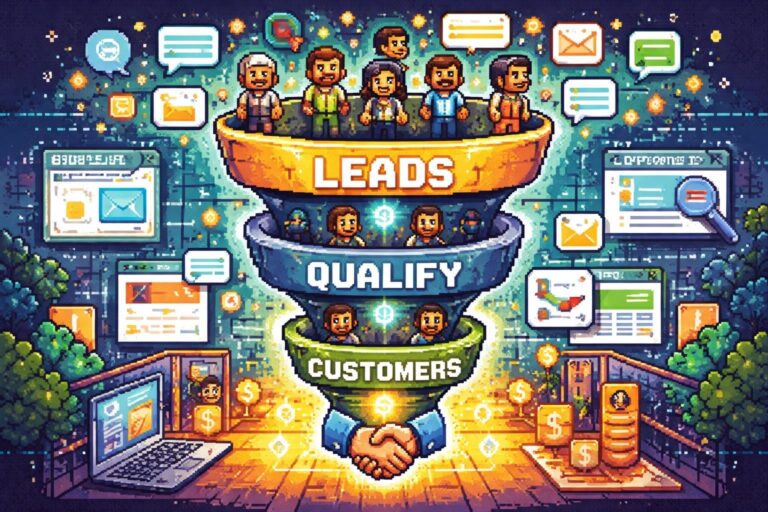
Break down your marketing agency lead generation into funnel stages: awareness, consideration, and decision. Each stage demands tailored messaging and offers.
For awareness, use educational blog posts and webinars. During consideration, share testimonials and case studies. At the decision stage, offer free audits or strategy sessions. Mapping this journey ensures leads experience a seamless path from first touch to client onboarding.
Budgeting and resource allocation
Allocate budget and resources to maximize your marketing agency lead generation efforts. Consider costs for paid ads, content creation, AI tools, and staffing.
Balance in-house activities with outsourced solutions. For example, investing in AI tools for agencies can automate prospecting and qualification, freeing your team for high-value work. Regularly review spend and ROI to ensure optimal allocation as your strategy evolves.
Integrating sales and marketing teams
Alignment between sales and marketing is critical for efficient marketing agency lead generation. Establish shared messaging, goals, and processes to ensure a smooth lead handoff.
Use integrated CRM and communication tools to track progress and maintain transparency. Weekly alignment meetings can help reduce lead leakage, improve collaboration, and drive better results for your agency.
Regularly reviewing and iterating your strategy
Continuous improvement is key in the dynamic world of marketing agency lead generation. Analyze performance data, solicit feedback from both clients and your team, and run A/B tests on messaging and channels.
Stay agile and adapt quickly to market shifts, emerging technologies, and changing client expectations. Regular reviews help you capitalize on what works, address gaps, and maintain a competitive edge in 2026.
Leveraging Advanced Tools and Technologies for Lead Generation
In the competitive world of marketing agency lead generation, advanced tools and technologies are essential for agencies aiming to boost efficiency and secure high-quality clients. Embracing innovation can help your agency stay ahead of the curve and maximize lead generation outcomes.
AI-powered prospecting and qualification tools
AI-driven platforms are transforming marketing agency lead generation by automating prospecting, list building, and lead scoring. These tools analyze data to identify high-potential prospects and personalize outreach at scale. Agencies using AI for prospecting report faster response times and improved lead quality. For example, AI email tools have led to 40 percent higher open rates, demonstrating their impact on pipeline growth and efficiency.
- Automate repetitive prospecting tasks
- Prioritize leads using smart scoring
- Personalize outreach at scale
Agencies leveraging these solutions see a measurable boost in qualified leads.
CRM systems and marketing automation
Centralized CRM systems and marketing automation platforms are crucial for streamlining marketing agency lead generation. By automating routine follow-ups and tracking every client interaction, agencies ensure no lead slips through the cracks. Popular solutions like HubSpot, Salesforce, and Zoho provide integrated dashboards, workflow automation, and analytics.
- Automated follow-ups and reminders
- Unified view of every lead touchpoint
- Real-time performance reporting
High-performing agencies that use automation consistently outperform competitors by optimizing resource allocation.
Conversational marketing and chatbots
Chatbots play a pivotal role in modern marketing agency lead generation, enabling 24/7 lead capture and qualification. With seamless integration across websites and messaging apps, chatbots engage prospects instantly and gather essential information.
For agencies interested in scalable automation, exploring Chatbot solutions for lead capture can streamline lead qualification and nurturing. These tools also provide valuable insights into user behavior, helping agencies refine their approach and increase conversion rates.
- Instant response to inquiries
- Automated qualification process
- Consistent lead data collection
Personalization and dynamic content tools
Personalization is a game-changer for marketing agency lead generation. Dynamic content platforms tailor website, email, and ad experiences to each visitor based on their behavior and preferences. This approach keeps prospects engaged and increases the likelihood of conversion.
- Personalized landing pages for each segment
- Adaptive email content based on interactions
- Real-time website recommendations
Agencies that invest in these tools see higher engagement rates and improved ROI, as prospects receive content relevant to their specific needs.
Data enrichment and intent data platforms
Data enrichment tools enhance marketing agency lead generation by providing deeper insights into leads. By gathering firmographic, technographic, and intent data, agencies can prioritize prospects who are most likely to convert.
- Identify decision-makers and company details
- Uncover buying intent signals
- Prioritize outreach based on readiness
Access to enriched data enables agencies to target the right accounts with the right message, improving efficiency and results.
Video prospecting and interactive content
Video prospecting and interactive content are powerful additions to the marketing agency lead generation toolkit. Personalized video outreach increases engagement, while interactive assets like quizzes and calculators act as compelling lead magnets.
- Record tailored video messages for prospects
- Use interactive case studies to demonstrate value
- Employ quizzes to capture lead information
Agencies that incorporate video prospecting report a 19 percent increase in response rates, making it a must-try tactic.
Integrating and optimizing your tech stack
Integrating your tools is critical for seamless marketing agency lead generation. An optimized tech stack ensures data flows smoothly between platforms, eliminating silos and redundancy.
- Connect CRM, chatbots, and analytics tools
- Regularly review tool performance and ROI
- Avoid overlapping or underused solutions
By continuously evaluating and refining your stack, your agency can maintain agility, adapt to new technologies, and scale lead generation effectively.
Optimizing Inbound Lead Generation Channels
Staying ahead in marketing agency lead generation requires a strategic approach to inbound channels. Inbound tactics attract prospects by offering value, building trust, and nurturing relationships. Agencies that master these channels consistently draw higher quality leads, reduce acquisition costs, and strengthen their market position.

Content marketing strategies for agencies
Content is the foundation of marketing agency lead generation. Agencies that publish insightful blog posts, whitepapers, and ebooks position themselves as industry authorities. Focused, high-value content tailored to client pain points not only educates but also builds credibility.
- Target industry-specific challenges in your writing.
- Use case studies to highlight real client successes.
- Optimize each piece for search engines and shareability.
A well-executed content plan can drive organic traffic and generate a sustained flow of inbound leads. Agencies often see their blogs contribute up to 60 percent of all inbound leads, confirming the impact of a strong content marketing strategy.
Webinars, podcasts, and virtual events
Interactive content formats are transforming marketing agency lead generation. Hosting webinars, podcasts, or virtual events allows agencies to demonstrate expertise and engage prospects in real time. These platforms foster direct conversations and showcase thought leadership.
- Invite industry experts or influential partners to join sessions.
- Address timely topics relevant to your target audience.
- Record and repurpose sessions for future content.
According to the Content Marketing Institute, 73 percent of B2B marketers consider webinars the most effective channel for high-quality leads. Virtual events also create networking opportunities that extend beyond the initial session, nurturing long-term relationships.
Social media and community engagement
Active participation in social platforms amplifies marketing agency lead generation. Establishing a presence on LinkedIn, Twitter, and niche communities increases visibility and opens doors to new prospects. Sharing case studies, testimonials, and behind-the-scenes insights humanizes your agency.
To supercharge results, agencies can leverage AI-powered tools for content creation and scheduling. Tools like AI-powered social content tools help streamline social media workflows, enabling agencies to produce engaging posts at scale and capture more inbound leads.
- Join relevant groups and participate in discussions.
- Respond promptly to comments and direct messages.
- Highlight client stories to build trust and authority.
Lead magnets and gated resources
Offering valuable resources in exchange for contact information is a proven marketing agency lead generation tactic. Lead magnets such as templates, checklists, and free audits incentivize prospects to share their details, populating your agency's pipeline with interested leads.
- Develop resources tailored to your target audience's challenges.
- Use clear, compelling calls-to-action on landing pages.
- Test different formats to see what resonates best.
Gated content not only drives conversions but also segments leads by interest, allowing for personalized follow-ups. An effective lead magnet can serve as the first touchpoint in a lasting client relationship.
SEO and organic traffic generation
Search engine optimization is vital for sustainable marketing agency lead generation. By targeting long-tail and local keywords, agencies can attract prospects actively searching for solutions. On-page optimization, technical SEO, and authoritative link building all contribute to organic visibility.
- Conduct regular keyword research to identify new opportunities.
- Optimize meta tags, headings, and site structure for clarity.
- Build relationships for quality backlinks.
A well-optimized website generates consistent inbound traffic. In fact, 57 percent of agency leads originate from organic search, underscoring the importance of a robust SEO strategy.
Referral and partnership programs
Word-of-mouth remains a powerful force in marketing agency lead generation. Encouraging satisfied clients to refer new business and forming partnerships with complementary service providers can expand your reach exponentially.
- Create a formal referral reward program.
- Co-host events or campaigns with technology partners.
- Share success stories to encourage advocacy.
Joint initiatives, such as webinars with CRM software companies, introduce your agency to new audiences. Partnerships also offer opportunities for cross-promotion, amplifying your inbound lead generation efforts.
Nurturing inbound leads with email marketing
Once leads enter your pipeline, nurturing them is critical. Automated email drip campaigns tailored to each stage of the buyer's journey keep your agency top-of-mind. Personalization increases engagement, while strategic timing improves conversion rates.
- Segment leads based on interests and behaviors.
- Deliver relevant content and case studies through email.
- Monitor engagement metrics to refine your approach.
Consistent, value-driven communication converts prospects into loyal clients. Agencies that prioritize lead nurturing maximize the return on their inbound marketing activities.
Mastering Outbound Lead Generation Tactics
Standing out in the crowded world of marketing agency lead generation requires a refined approach to outbound tactics. As agencies move into 2026, leveraging a blend of technology, personalization, and creativity is essential for connecting with high-value prospects and converting them into loyal clients.
Modern cold outreach strategies
Cold outreach has evolved far beyond generic email blasts. Today, agencies embrace hyper-personalized email and LinkedIn messaging to break through the noise. Video introductions, voice notes, and interactive content now power first impressions.
- Personalizing subject lines and opening sentences
- Referencing mutual connections or recent company news
- Using video and interactive elements for engagement
Agencies that integrate these tactics into their marketing agency lead generation efforts experience higher response rates and more meaningful conversations.
Account-based marketing (ABM) for agencies
ABM targets specific high-value accounts with tailored campaigns. Agencies identify key decision-makers within target organizations and develop custom messaging to address their unique pain points.
Coordination across channels, such as email, social, and direct mail, ensures consistent messaging and increases the likelihood of engagement. ABM is a cornerstone of marketing agency lead generation, driving stronger relationships and boosting client acquisition for agencies focused on quality over quantity.
Leveraging intent and predictive analytics
Modern marketing agency lead generation relies on real-time data to identify companies actively searching for agency services. Intent data platforms and predictive analytics tools help agencies prioritize outreach, focusing on prospects with high purchase intent.
As Generative AI Adoption in Marketing shows, more than 80 percent of marketers are using AI-powered tools to drive ROI, making data-driven outbound efforts the new standard.
Cold calling in the digital age
While digital channels dominate, cold calling remains a valuable tool in the marketing agency lead generation toolkit. Modern calling strategies integrate research-driven scripts and are often paired with email or LinkedIn outreach for a multi-touch approach.
Successful agencies train their teams to reference pain points and recent company developments, making each call relevant and timely. This approach improves connection rates and helps build trust from the first conversation.
Direct mail and creative outreach
Direct mail is making a comeback as inboxes grow more crowded. Agencies are sending personalized packages, handwritten notes, and creative gifts that capture attention and spark curiosity.
- Branded merchandise
- Custom event invitations
- Unique, tactile experiences
When combined with digital follow-up, these creative tactics add a memorable touch to any marketing agency lead generation campaign.
Event networking and industry conferences
In-person and virtual events remain powerful for building authority and establishing genuine relationships. Agencies attend, sponsor, or speak at industry conferences to connect with prospects and showcase expertise.
Effective follow-up after events is critical for converting warm leads. By integrating event contacts into ongoing nurturing workflows, agencies maximize their marketing agency lead generation outcomes.
Overcoming common outbound challenges
Outbound marketing agency lead generation comes with hurdles, including spam filters, regulatory compliance, and gatekeepers. Agencies overcome these by:
- Using verified sending domains and clean lists
- Personalizing every outreach
- Staying informed about evolving privacy regulations
Continuous measurement and optimization ensure outbound tactics remain effective, scalable, and compliant as the landscape evolves.
Measuring, Analyzing, and Scaling Your Lead Generation Efforts
In the competitive world of marketing agency lead generation, measurement and analysis are your compass. Without clear data, even the most creative campaigns can go astray. Successful agencies treat analytics not as an afterthought but as the foundation for growth and efficiency.
Setting up tracking and analytics
Start with precise tracking for every marketing agency lead generation touchpoint. Implement UTM parameters on all links, use call tracking for phone leads, and integrate your CRM with analytics tools.
Here is a quick comparison of popular analytics solutions:
| Tool | Best For | Notable Feature |
|---|---|---|
| Google Analytics | Website traffic & conversions | Free, customizable |
| HubSpot | End-to-end lead tracking | CRM integration |
| Salesforce | Pipeline management | Advanced reporting |
Consistent tracking ensures no lead is lost, and every interaction is measured.
Defining and monitoring key performance indicators (KPIs)
KPIs are the heartbeat of marketing agency lead generation. Define metrics that matter, such as lead volume, conversion rates, cost per lead, and pipeline velocity.
Consider this sample KPI table:
| KPI | Definition |
|---|---|
| Lead Volume | Number of new leads per period |
| Conversion Rate | % of leads becoming clients |
| Cost Per Lead | Total spend divided by leads |
| Pipeline Velocity | Speed from lead to client |
Regularly monitor these KPIs to identify trends and act swiftly.
Attribution modeling and multi-touch analysis
Understanding which channels drive results is vital for marketing agency lead generation. Attribution modeling assigns value to each interaction in a lead’s journey. Use first-touch, last-touch, and multi-touch models to see the full picture.
Multi-touch attribution, for example, can reveal that a blog post sparked initial interest, but a webinar closed the deal. Agencies adopting advanced attribution have improved ROI by 18 percent.
Running A/B tests and experiments
A/B testing is a proven way to refine your marketing agency lead generation efforts. Test subject lines, landing pages, offers, and timing. Even small tweaks can lead to a 15 percent lift in conversion rates.
Use a structured approach:
- Identify one variable to test.
- Split your audience evenly.
- Analyze results and implement the winner.
Continuous experimentation fuels optimization and growth.
Using feedback loops to improve lead quality
Feedback loops are essential for aligning sales and marketing. Collect input from sales teams and clients about lead fit and readiness. This information helps refine targeting and messaging for future campaigns.
Research on AI Collaboration in Marketing Teams shows that integrating AI-driven insights accelerates feedback cycles and improves decision-making. Agencies that embrace these practices see higher lead quality and satisfaction.
Scaling successful strategies
Once you identify what works in marketing agency lead generation, scale those strategies. Double down on high-performing channels and automate repeatable processes. For example, automating webinar follow-ups can double your lead-to-client conversion rates.
As AI continues to transform the industry, agencies should monitor developments like AI’s Impact on Marketing Agencies, which highlights how leading firms use AI for efficiency and innovation.
Avoiding common pitfalls and mistakes
Avoid relying on a single channel for marketing agency lead generation. Regularly review processes to prevent stagnation. Stay compliant with privacy laws and industry regulations.
Common pitfalls include:
- Neglecting data hygiene
- Failing to align sales and marketing
- Ignoring regulatory updates
By proactively addressing these issues, you set your agency up for sustained growth.





3 Comments