

Lead Generating Website Guide for 2025: Boost Your Leads
In 2025, the digital marketplace is more crowded than ever, making it essential for your business to stand out and succeed. Simply having an attractive site is no longer enough—your lead generating website must actively drive new business opportunities.
This guide will show you the critical strategies, tools, and best practices needed to turn your site into a powerful lead generating website. Whether you are a business owner, marketer, or web professional, you will discover actionable steps to build and optimize your site for higher conversions.
We will cover everything from the core anatomy of a high-performing site to the latest AI tools, proven content and UX tactics, and the key metrics you need to track for ongoing success. Let’s unlock your website’s true potential and boost your leads in the coming year.
The Anatomy of a High-Converting Lead Generating Website
A high-converting lead generating website is the foundation of digital growth in 2025. Businesses that understand the anatomy of such a site can consistently capture and nurture new prospects. Each element, from design to analytics, plays a critical role in converting visitors into valuable leads.

Understanding Lead Generation Fundamentals
A lead generating website is designed to turn visitors into actionable contacts for your sales pipeline. Unlike informational sites, which mainly provide details, a lead generating website focuses on guiding users toward conversions.
The core elements include a clear value proposition, visible trust signals, and multiple conversion paths. For example, compare a static brochure site that simply lists services to a conversion-optimized landing page featuring compelling CTAs and lead forms. According to HubSpot (2023), 68% of B2B businesses now rely on their website as their primary lead generation channel.
For a deeper dive into effective strategies, see 10 Proven Strategies for Website Lead Generation in 2025.
Essential Website Features for Lead Capture
To maximize results, a lead generating website must use proven capture features. Well-placed forms should be short, easy to complete, and tailored to the audience. Live chat or AI-powered chatbots provide instant engagement, answering questions and capturing leads in real time.
Gated content, such as eBooks or whitepapers, can incentivize sign-ups for valuable information. For example, a SaaS company increased conversions by 30% after integrating a smart chatbot. Ensuring mobile optimization is also critical, as users expect seamless experiences across all devices.
Conversion-Driven Design Principles
Design impacts every aspect of a lead generating website. Start with a strong visual hierarchy that guides visitors to your calls to action. Use contrasting CTA buttons and actionable copy to encourage clicks.
Trust-building elements like testimonials, reviews, and security badges reassure visitors. FOMO triggers, such as countdowns or limited-time offers, can boost urgency. Notably, adding testimonials can increase conversions by up to 34% (VWO, 2023).
Optimizing User Experience (UX) for Lead Generation
A smooth user experience is essential for any lead generating website. Fast load times and intuitive navigation keep visitors engaged. Clean, distraction-free layouts help users focus on your offer.
Accessibility should be a priority to ensure all users can interact with your site. As an example, a retailer reduced their bounce rate by 25% after simplifying their navigation. Continuous A/B testing allows you to refine UX and maximize conversions.
Integrating Analytics and Tracking Tools
Effective analytics are the backbone of a successful lead generating website. Set up Google Analytics and conversion tracking to monitor user behavior. Tools like heatmaps and session recordings reveal where visitors drop off.
Integrating your site with CRM and email platforms streamlines lead management. Deloitte (2023) found that companies using analytics are five times more likely to make fast, data-driven decisions. One B2B firm doubled its leads by optimizing its website based on analytics insights.
Step-by-Step Process to Build a Lead Generating Website in 2025
Building a lead generating website in 2025 requires a focused, data-driven approach. Each step below forms the foundation for long-term success, ensuring your site not only attracts visitors but also converts them into valuable leads.

Step 1: Define Your Target Audience and Lead Goals
Every high-performing lead generating website starts with a deep understanding of its audience. Begin by researching buyer personas and uncovering their core pain points. Use surveys, interviews, and analytics to gather insights.
Next, set SMART objectives for your lead generation efforts. This could mean targeting a specific number of qualified leads per month, or increasing conversion rates by a set percentage.
Segment your audience for more personalized experiences. For example, an e-commerce brand can create separate lead magnets for first-time buyers versus returning customers. By aligning goals and audience insights, your lead generating website will be positioned for maximum relevance and impact.
Step 2: Craft a Compelling Value Proposition
Your lead generating website must clearly communicate what sets your business apart. Focus on the unique benefits and solutions you offer, not just product features.
Align your messaging with your audience’s needs. Use strong, clear headlines and supporting subheadings to ensure your value proposition stands out on every page.
For instance, a SaaS company refined its homepage messaging to directly address customer pain points, resulting in a noticeable uptick in sign-ups. When your value proposition speaks directly to your target audience, you increase the likelihood of converting visitors into leads.
Step 3: Design High-Converting Landing Pages
A lead generating website thrives on focused, conversion-driven landing pages. Each page should have a single, clear goal—such as capturing an email address or booking a demo.
Eliminate distractions by minimizing navigation options and using a strong, prominent CTA. Incorporate visual storytelling elements and social proof, such as testimonials or trust badges, to build credibility.
According to WordStream, landing pages featuring just one CTA convert 202% better than those with multiple calls to action. By simplifying your landing pages, your lead generating website will guide visitors smoothly toward conversion.
Step 4: Implement Advanced Lead Capture Mechanisms
To maximize results, your lead generating website needs versatile lead capture tools. Use pop-ups, slide-ins, and exit-intent offers to engage visitors at key moments without disrupting their experience.
Multi-step forms can improve completion rates by breaking down information into manageable steps. Progressive profiling lets you gather more data from returning users without overwhelming them initially.
Consider this example: a B2B firm increased conversions by 40% after switching to multi-step forms. Optimizing your lead capture process ensures your lead generating website collects more qualified leads with less friction.
Step 5: Leverage Automation and AI Tools
Automation and AI are transforming how businesses manage and scale lead generation. Integrate automated email workflows and nurturing sequences to engage leads at the right time.
AI chatbots provide 24/7 support, qualifying and segmenting leads instantly. For insights into the most effective solutions, explore the Top 10 AI Tools for Lead Generation in 2025, which reviews the latest innovations in this space.
By embracing automation, your lead generating website can deliver a seamless, personalized experience that boosts both efficiency and conversion rates.
Step 6: Test, Analyze, and Optimize Continuously
Ongoing optimization is vital for a lead generating website to maintain peak performance. Run A/B and multivariate tests on forms, CTAs, and layouts to identify what works best.
Monitor essential metrics such as conversion rate, bounce rate, and lead quality. Use insights from analytics to drive iterative improvements.
For example, a startup doubled its leads by tweaking form length and CTA copy based on test results. Treat your lead generating website as a living asset, always evolving to meet changing user behaviors and expectations.
Harnessing AI and Automation for Maximum Lead Generation
AI and automation are transforming how businesses approach lead generation. In 2025, staying ahead means integrating these intelligent technologies into your lead generating website to capture, qualify, and nurture leads with unprecedented efficiency. Let’s explore the essential AI-powered strategies and tools you need to maximize results.
The Role of AI in Modern Lead Generation
AI is reshaping the landscape for every lead generating website. Machine learning algorithms analyze visitor data in real time, offering personalized content and recommendations tailored to each user’s interests. Predictive analytics help businesses spot high-value prospects early, allowing for more precise targeting.
For example, an e-commerce site using AI-driven product suggestions can significantly boost lead quality and sales. According to Statista, 74% of marketers report that AI improves lead scoring accuracy, making their lead generating website more effective and data-driven.
AI’s ability to anticipate user needs and adapt content on the fly keeps visitors engaged, which is crucial for converting traffic into qualified leads.
Custom Chatbots and Conversational Marketing
Chatbots have become an indispensable feature for any modern lead generating website. These AI-powered assistants provide 24/7 engagement, instantly responding to queries and guiding users through the conversion process.
Through conversational marketing, chatbots can qualify and segment leads as they interact, booking demos, answering FAQs, and recommending resources. For example, a financial services firm reduced lead response time by 80% after deploying a custom chatbot.
Adding chatbots to your lead generating website ensures no opportunity slips through the cracks, delivering faster, more personalized experiences that drive results.
ToolStacked: AI Business Tools for Lead Generation
ToolStacked offers a comprehensive suite of AI business tools designed to supercharge your lead generating website. Their custom chatbot solutions range from simple FAQ bots to advanced AI-powered assistants, all tailored for lead capture, qualification, and nurturing.
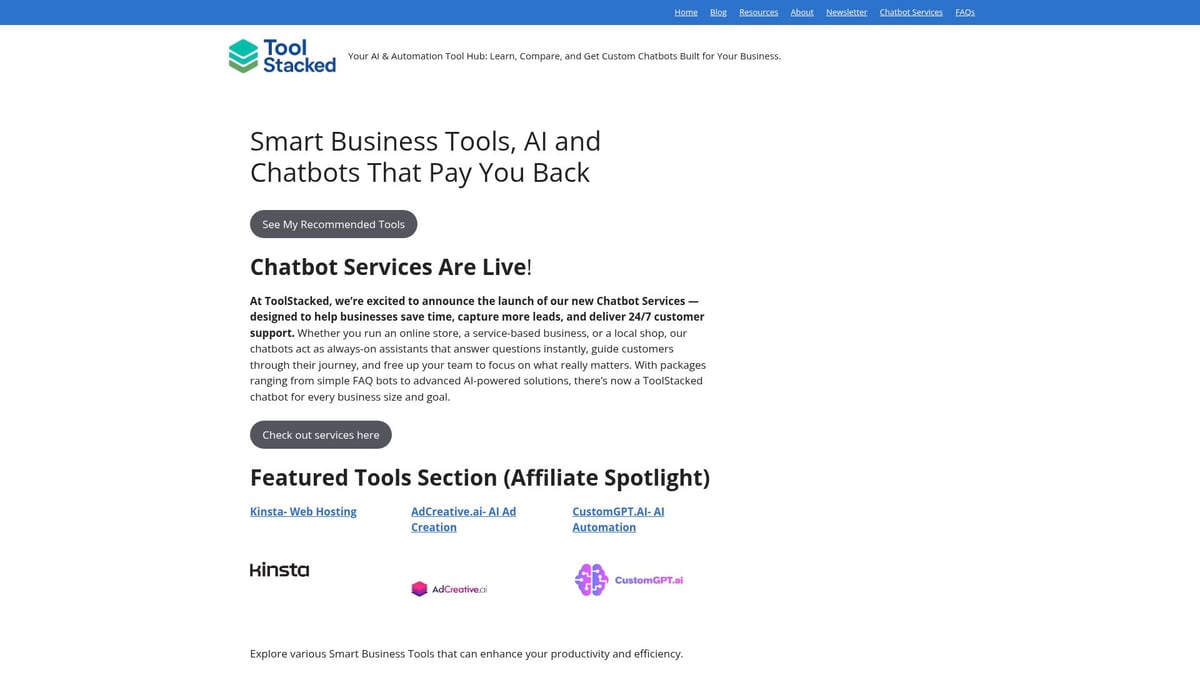
By leveraging AI business tools for lead generation, businesses can automate repetitive tasks, boost conversion rates, and save valuable time. ToolStacked also features curated reviews and educational resources to help you select and implement the right solutions. SMBs using ToolStacked report up to a 35% increase in qualified leads, showcasing the tangible benefits of AI integration.
Marketing Automation Platforms and Integrations
Marketing automation is essential for scaling your lead generating website. Platforms like HubSpot and ActiveCampaign enable automated nurturing using email workflows and drip campaigns, ensuring timely follow-ups with every lead.
Seamless integration with CRM and sales tools creates a unified view of the customer journey. Multi-channel automation, including SMS, web push, and social messaging, broadens your reach. Campaign Monitor reports that automated emails generate 320% more revenue than non-automated campaigns.
With automation, your lead generating website works around the clock, engaging prospects and moving them closer to conversion without manual intervention.
Predictive Analytics and Lead Scoring
Predictive analytics uses machine learning to score and prioritize leads on your lead generating website. By analyzing patterns in user behavior, it identifies which visitors are most likely to convert, allowing for targeted outreach.
Sales teams benefit from real-time alerts when high-intent leads are detected, ensuring immediate follow-up. For example, a B2B SaaS company improved sales efficiency by using predictive lead scoring to focus efforts on the most promising prospects.
Incorporating predictive analytics into your lead generating website ensures resources are allocated wisely, maximizing return on investment and accelerating growth.
Content, SEO, and UX Strategies to Drive Targeted Traffic and Conversions
Attracting qualified visitors and converting them is at the heart of every successful lead generating website. To achieve this, you need a comprehensive approach that blends high-value content, targeted SEO, seamless user experience, personalization, and trust signals. Let us explore the essential strategies that turn ordinary sites into conversion powerhouses.

Creating Lead Magnet Content That Converts
A lead generating website thrives on content that addresses specific audience needs. Lead magnets such as eBooks, checklists, webinars, and detailed case studies offer tangible value in exchange for contact details.
Align each content offer with the visitor's stage in the buyer journey. Early-stage leads may prefer quick guides or checklists, while decision-stage prospects engage with in-depth whitepapers or industry reports.
For example, a consulting firm saw its lead volume surpass 500 per month by regularly promoting gated industry reports tailored to executive pain points. Remember, content marketing generates three times more leads than outbound strategies, making it a foundational pillar for your lead generating website.
SEO Essentials for Lead Generating Websites
SEO ensures your lead generating website attracts the right visitors at the right time. Start with keyword research focused on user intent and common pain points. Optimize on-page elements including meta tags, headings, and internal links to guide both users and search engines.
Technical SEO is equally important. Prioritize fast site speed, mobile responsiveness, and schema markup for enhanced visibility. Local service businesses, for instance, have boosted organic leads by 60 percent after a comprehensive SEO overhaul.
For additional strategies on improving performance, explore website hosting and optimization tips. Robust hosting and smart optimization keep your lead generating website running at peak efficiency across all devices.
Building Trust and Authority Through Content
Trust is non-negotiable for any lead generating website. Showcase testimonials from satisfied clients, detailed case studies, and relevant certifications to reassure visitors of your credibility.
Educational blog posts and industry insights position your brand as a thought leader. Guest posting on reputable sites and earning backlinks further establish your site's authority. In fact, 81 percent of buyers trust advice from blogs and recognized experts.
A steady cadence of transparent, data-driven content builds both confidence and rapport, making users more likely to engage with your lead generating website.
Enhancing UX for Higher Engagement and Lower Bounce Rates
User experience is a key differentiator for any lead generating website. Fast-loading pages and responsive design ensure smooth browsing on all devices. Clear navigation guides users effortlessly to conversion points, reducing friction and abandoned sessions.
Implement accessibility best practices so everyone can interact with your site. For instance, a SaaS provider cut its bounce rate by 22 percent after a targeted UX redesign focused on clarity and simplicity.
Consistent UX improvements, informed by user feedback and analytics, keep your lead generating website ahead of evolving user expectations.
Personalization and Dynamic Content Strategies
Personalization takes your lead generating website to the next level by tailoring content, calls to action, and offers to each visitor segment. Use dynamic CTAs based on user behavior, and recommend content or products that match individual interests.
AI-driven personalization tools can boost conversions dramatically. According to Econsultancy, personalized web experiences increase conversions by 202 percent. To discover top solutions, see the 13 Best AI Lead Generation Tools I’ve Tested in 2025. These tools enable your lead generating website to deliver relevant content at scale, improving both engagement and lead quality.
Leveraging Social Proof and Community
Social proof reassures visitors that your lead generating website is both popular and trustworthy. Display recent sign-ups, customer logos, and user counts to build instant credibility.
Integrate third-party reviews and ratings, and encourage user-generated content such as testimonials or case studies. Live purchase notifications or real-time activity feeds can further reinforce trust.
For example, an e-commerce site increased conversions by showcasing live purchase notifications and customer reviews, demonstrating active engagement and community trust in their lead generating website.
Tracking, Measuring, and Optimizing Lead Generation Performance
To turn your lead generating website into a sustainable growth engine, you need robust tracking, measurement, and ongoing optimization. This process ensures every marketing effort translates into real, qualified leads. Let’s break down how to monitor results, make data-driven decisions, and scale your lead generating website for long-term success.
Key Metrics for Lead Generation Websites
Measuring the right metrics is essential for any lead generating website. Core indicators include conversion rate, cost per lead, and lead quality score. Traffic sources and attribution modeling help you understand where your best leads originate.
| Metric | Purpose |
|---|---|
| Conversion Rate | Measures website effectiveness |
| Cost per Lead | Tracks campaign efficiency |
| Lead Quality Score | Assesses likelihood to convert |
| Traffic Source | Identifies top channels |
According to HubSpot, top-performing websites track at least seven lead gen metrics to ensure a holistic view of performance. Regularly reviewing these numbers helps you optimize your lead generating website for better results.
Setting Up Analytics and Reporting Dashboards
To accurately track your lead generating website, set up Google Analytics 4 for event and goal tracking. Custom dashboards in Data Studio or similar tools visualize key performance indicators at a glance. Integrate your CRM data for closed-loop reporting, enabling you to connect website actions to actual sales outcomes.
A marketing agency, for example, improved campaign ROI by consolidating analytics and CRM data into unified dashboards. This approach allowed the team to spot trends quickly and act on insights, keeping their lead generating website ahead of the curve.
A/B Testing and Conversion Rate Optimization (CRO)
Continuous improvement is vital for a high-performing lead generating website. A/B and multivariate tests let you experiment with different form designs, CTA placements, and page layouts. Use tools like Optimizely, Google Optimize, or VWO to run tests and interpret results.
Businesses that run A/B tests see an average 49 percent lift in conversions, according to Invesp. For further inspiration, explore 7 AI Marketing Tools to Automate Lead Generation in 2025 to discover how AI can enhance your testing and optimization processes.
Using Feedback Loops to Refine Lead Generation
A successful lead generating website relies on user feedback for ongoing refinement. Collect insights through surveys, chatbots, and session replays. Heatmaps reveal areas where users drop off, guiding your next improvements.
A SaaS firm increased demo requests by 18 percent after acting on feedback from their lead generating website. Read how first impressions testing with CustomGPT AI can help you better understand visitor reactions and optimize for engagement.
Scaling Up: From Initial Success to Ongoing Growth
Once your lead generating website is performing well, focus on scaling. Identify channels and tactics that deliver consistent results, then automate repetitive optimization tasks. Foster a culture of experimentation and data-driven decision-making to keep improving.
Companies that continually optimize generate twice as many leads year over year, according to MarketingSherpa. For example, an e-commerce brand tripled its lead volume by expanding successful campaigns and leveraging new automation tools. Consistent tracking and agile adjustments are the keys to lasting growth for your lead generating website.






One Comment