
Machine Learning and Business Intelligence Versus: Key Differences 2025
In 2025, organizations are witnessing the rapid convergence of machine learning and business intelligence. Both fields are transforming how companies understand and act on data, yet their core functions remain unique.
The explosive growth in data and artificial intelligence has left many business leaders questioning which path to follow. Should you invest in machine learning and business intelligence together, or focus on one approach?
This guide brings clarity to the ongoing debate. Here, decision-makers will find actionable insights to confidently shape digital strategies for 2025 and beyond.
We’ll break down definitions, core features, data needs, practical applications, and the evolving relationship between machine learning and business intelligence.
Defining Business Intelligence and Machine Learning
Understanding the difference between business intelligence (BI) and machine learning (ML) is foundational for any organization aiming to harness data for strategic advantage. As the boundaries between these fields blur in 2025, it is vital to clarify what each brings to the table and how they shape business outcomes.
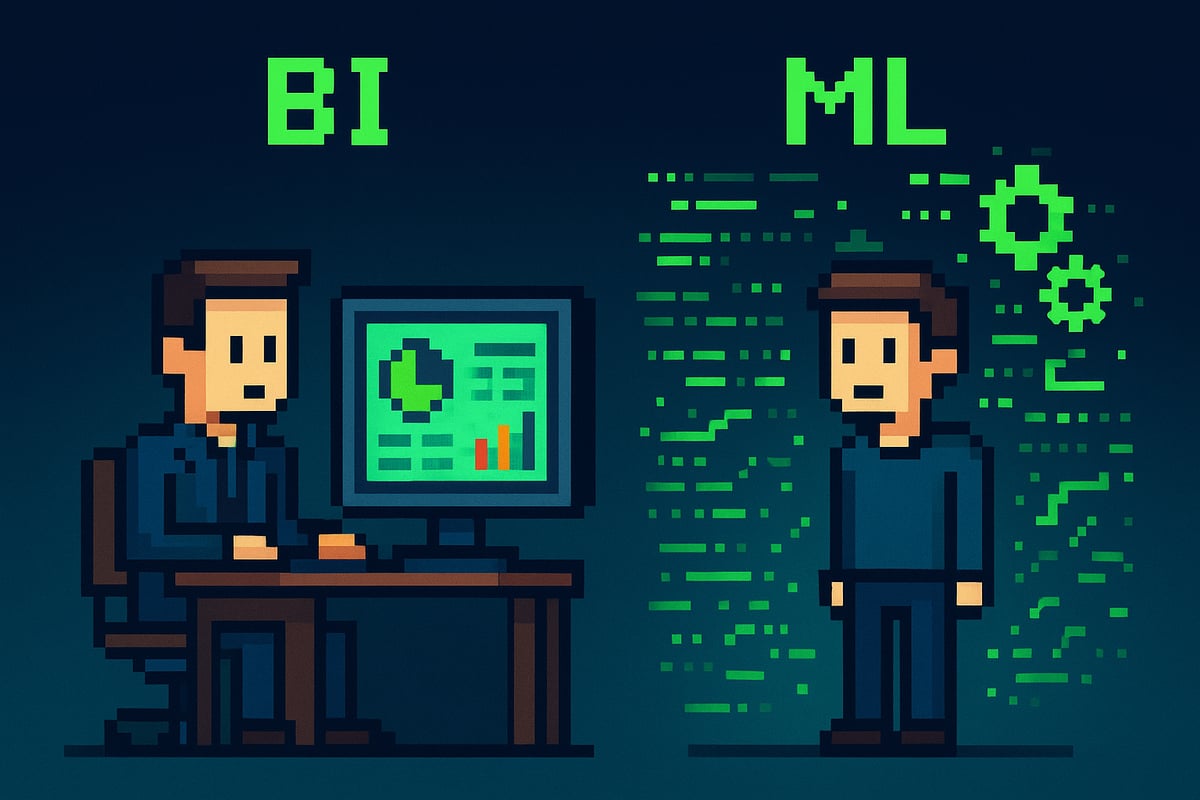
What is Business Intelligence?
Business intelligence refers to a comprehensive set of tools, applications, and best practices designed for collecting, integrating, analyzing, and presenting business data. The main goal of BI is to support informed decision-making by transforming raw data into actionable insights.
BI platforms typically focus on analyzing historical and real-time structured or semi-structured data. Outputs are often presented as interactive dashboards, scheduled reports, data visualizations, and performance scorecards. These outputs empower business analysts, executives, and decision-makers to monitor key metrics and spot trends.
For example, a sales team might use Tableau or Power BI to visualize sales performance across regions and identify patterns over time. BI platforms excel at handling data from CRMs, ERPs, and internal databases, where the data is well-organized and easy to query.
Despite advances, BI traditionally emphasizes structured data. However, industry studies show up to 80% of business value can come from unstructured data sources, indicating a growing need for BI tools to expand their reach. Still, when it comes to machine learning and business intelligence, BI remains the go-to for descriptive analytics and operational reporting.
What is Machine Learning?
Machine learning is a specialized field within artificial intelligence that builds algorithms capable of learning from data with minimal human intervention. The core strength of ML lies in its ability to detect patterns, predict outcomes, and automate decision-making processes using vast and complex datasets.
ML is not limited to structured or semi-structured data. It can process unstructured information like text, images, and sensor signals, making it highly adaptable. Its typical outputs include predictive models, automated recommendations, and real-time forecasts.
Data scientists, ML engineers, and developers are the primary users of machine learning and business intelligence in this context. They design and tune algorithms that power systems such as Amazon’s recommendation engine or advanced fraud detection platforms in banking.
A key advantage is scalability. ML can analyze datasets far beyond the scope of manual analysis, learning and improving as more data becomes available. This allows organizations to move from reactive reporting to proactive business strategies, leveraging the full potential of machine learning and business intelligence.
Core Philosophies and Approaches
At their core, business intelligence and machine learning are built on distinct philosophies. BI is inherently retrospective and descriptive, focusing on understanding what has happened in the business by analyzing past and current data. It often relies on static rules, manual queries, and domain expertise.
In contrast, ML is predictive and prescriptive. It uses data to forecast future events and automate responses, adapting its models as new information arrives. ML algorithms evolve over time, identifying subtle patterns that static BI queries may overlook.
To illustrate these differences, consider this table:
| Aspect | Business Intelligence | Machine Learning |
|---|---|---|
| Main Focus | Descriptive, retrospective | Predictive, prescriptive |
| Data Types | Structured, semi-structured | Structured, semi/unstructured |
| Approach | Rules, queries, dashboards | Algorithms, models, automation |
| Users | Analysts, executives | Data scientists, developers |
| Example Output | Sales dashboard | Churn prediction |
For a deeper dive into these distinctions, see Key Differences Between Business Intelligence and Machine Learning, which elaborates on methodologies and practical use cases.
Understanding how machine learning and business intelligence differ in philosophy and approach is crucial for organizations seeking to match the right tool to their business goals.
Core Functionalities and Use Cases
Understanding the core functionalities and real-world applications of machine learning and business intelligence is essential for organizations planning their technology strategy in 2025. Both approaches help businesses uncover insights and drive performance, yet their methods and outputs differ in meaningful ways.

Business Intelligence Functionalities and Use Cases
Business intelligence focuses on transforming raw data into actionable insights for decision-makers. At its core, machine learning and business intelligence platforms collect, integrate, and analyze data to support business goals.
Key functionalities include:
- Data aggregation and cleansing from multiple sources
- Centralized data warehousing for consistency
- Interactive dashboards and self-service reporting tools
- Trend and pattern identification in business operations
- Real-time monitoring of key performance indicators (KPIs)
BI tools like Tableau, Power BI, and QlikView are widely adopted for their intuitive interfaces and robust visualization options. For example, a sales team might use Power BI to analyze quarterly trends, spot regional differences, and generate reports for executives. Another common use is financial analysis, where BI helps track budgets, expenses, and revenue over time.
Customer segmentation is another frequent BI application. By slicing data across demographics or behaviors, businesses can tailor marketing strategies and improve service delivery. BI’s structured approach accelerates reporting cycles and enables rapid, informed decisions.
Statistics show that organizations using machine learning and business intelligence can achieve much faster reporting and improve operational efficiency, making these tools indispensable for modern business analysis.
Machine Learning Functionalities and Use Cases
Machine learning and business intelligence are increasingly intertwined, but ML’s core strength lies in pattern recognition, prediction, and automation. ML systems build models that learn from data, adapting over time to improve accuracy and outcomes.
Core ML functionalities include:
- Automated detection of patterns and anomalies in large datasets
- Predictive analytics for sales forecasts, risk assessment, or churn prediction
- Recommendation engines that personalize user experiences
- Real-time processing for instant decision-making, such as fraud detection
ML frameworks like TensorFlow, PyTorch, and scikit-learn support these capabilities. For instance, manufacturers use ML for predictive maintenance, monitoring sensor data to anticipate equipment failures before they occur. In e-commerce, dynamic pricing algorithms adjust product prices based on demand, competition, and inventory levels.
A standout example is the use of AI-powered analytics tools such as those reviewed in the Predis.ai review for businesses, which demonstrate how machine learning and business intelligence can work together to provide actionable business insights.
Studies indicate that ML models can boost forecast accuracy by up to 20 percent in some industries. As a result, organizations adopting machine learning and business intelligence solutions gain a competitive edge by automating complex analysis and driving smarter decisions.
Overlapping and Complementary Use Cases
While machine learning and business intelligence have distinct functions, their overlap is growing. Both identify trends and support decision-making, but ML extends capabilities by automating predictions and actions.
For example, a BI dashboard may reveal declining sales in a product line. An embedded ML model can analyze customer behavior to predict which products are likely to rebound, helping leaders act with greater confidence. Increasingly, BI platforms are incorporating ML features for advanced analytics, such as automated insights and anomaly detection.
Research shows that 90 percent of organizations plan to integrate AI and ML into BI platforms by 2025, highlighting the importance of combining machine learning and business intelligence for future-ready analytics.
Data Requirements, Sources, and Processing
The foundation of successful machine learning and business intelligence initiatives is robust, high-quality data. Both disciplines require careful attention to where data comes from, how it is structured, and the processes used to prepare it for analysis. However, their requirements and approaches to data differ in important ways.

Data in Business Intelligence
Business intelligence relies heavily on structured and semi-structured data drawn from internal business systems. Common sources include enterprise resource planning (ERP) platforms, customer relationship management (CRM) databases, and other transactional systems. This data is typically organized into rows and columns, making it easier to analyze and visualize.
Before analysis, data must undergo extensive cleaning, normalization, and transformation. These steps are often part of the extract, transform, load (ETL) process, which is foundational to business intelligence workflows. ETL ensures that the data is accurate, consistent, and ready for reporting.
Despite the value of unstructured data, traditional business intelligence platforms focus mostly on structured sources. This focus can limit insights, as unstructured data like emails or social media posts is often left unused. For example, a sales team might use BI tools to analyze structured sales data from their CRM, identifying quarterly trends and performance metrics.
Data in Machine Learning
Machine learning and business intelligence differ significantly in their approach to data diversity and complexity. Machine learning systems are designed to handle structured, semi-structured, and unstructured data. This includes text, images, audio, sensor streams, and more.
To train effective models, machine learning requires large and varied datasets. Data preparation tasks such as labeling, feature engineering, and handling missing values are essential. These steps help algorithms learn relevant patterns and improve predictive power.
Unlike traditional business intelligence, machine learning can incorporate external data sources. Examples include scraping social media for sentiment analysis or using IoT sensor data for predictive maintenance. The ability to process unstructured and real-time data allows machine learning applications to uncover deeper insights and support more complex use cases.
Real-Time vs. Historical Data Processing
A key distinction between machine learning and business intelligence is how they process data over time. Business intelligence has traditionally focused on analyzing historical and near-real-time data for reporting and decision support. Monthly or quarterly reports are common outputs, helping organizations understand past performance.
Machine learning, on the other hand, increasingly excels at real-time data processing. Algorithms can analyze streaming data and trigger actions instantly, such as flagging potential fraud or adjusting pricing based on demand. This capability is transforming how organizations respond to dynamic market conditions.
The trend toward real-time analytics is accelerating in both fields, as companies seek to stay competitive and secure. According to AI-Driven Business Intelligence Trends for 2025, integrating AI and ML into BI platforms is enabling more advanced, automated insights from both historical and live data streams. As the boundary blurs, organizations must invest in infrastructure that supports the demanding data needs of both machine learning and business intelligence.
Methodologies, Tools, and Technologies
Understanding the methodologies, tools, and technologies behind machine learning and business intelligence is crucial for organizations navigating digital transformation. Both domains offer unique capabilities, yet their convergence is transforming analytics in 2025.

Business Intelligence Methodologies and Tools
Business intelligence relies on robust methodologies for extracting actionable insights from organizational data. Key approaches include OLAP for multidimensional analysis, data warehousing for centralized storage, and dashboarding for visual reporting.
Popular BI tools like Tableau, Power BI, and QlikView empower users to create interactive dashboards and reports without deep technical expertise. These platforms often feature drag and drop interfaces, making data exploration accessible to business users. Query languages such as SQL and MDX allow for customized data retrieval and manipulation.
A typical workflow starts with ETL processes, which extract, transform, and load data from various sources into a warehouse. From there, users can analyze historical and real time data, track KPIs, and spot trends. These tools are essential for organizations leveraging machine learning and business intelligence to streamline reporting and accelerate informed decision making.
| BI Tool | Key Methodology | User Type |
|---|---|---|
| Tableau | Visualization, OLAP | Business Analyst |
| Power BI | Dashboarding, ETL | Executive |
| QlikView | Data Discovery | Manager |
Machine Learning Methodologies and Tools
Machine learning and business intelligence diverge in the methodologies and tools used for advanced analytics. Machine learning emphasizes algorithmic learning from data, enabling predictive and prescriptive insights.
Common methodologies include supervised learning (for classification and regression), unsupervised learning (for clustering and pattern discovery), and reinforcement learning (for adaptive decision making). Algorithms like linear regression, decision trees, and neural networks form the backbone of these applications.
Popular machine learning frameworks such as TensorFlow, PyTorch, and scikit-learn provide powerful libraries for building and deploying models. These tools require expertise in coding and statistics, often involving Python or R. Data scientists use these frameworks to develop solutions like churn prediction, fraud detection, and recommendation engines.
A typical ML workflow involves data preparation, feature engineering, model training, and evaluation. Unlike traditional BI, machine learning and business intelligence in this context focus on automating insights and evolving with new data.
Integration and Hybrid Approaches
The convergence of machine learning and business intelligence is reshaping analytics platforms in 2025. Modern BI tools now embed machine learning capabilities, enabling users to access automated insights, anomaly detection, and predictive analytics directly within their dashboards.
For example, Power BI’s AI Insights integrates ML models for advanced data analysis, while other platforms allow seamless import of ML outputs into BI reports. This integration empowers organizations to leverage both descriptive and predictive analytics for holistic decision making.
Hybrid environments combine the strengths of machine learning and business intelligence, fostering unified analytics. Teams can visualize ML predictions alongside traditional BI metrics, making data driven decisions faster and more accurately. As highlighted in Future Business Intelligence Trends to Watch in 2025, the integration of AI and ML into BI platforms is a defining trend, driving innovation and transforming how data is used across industries.
Organizations adopting hybrid solutions report improved agility, deeper insights, and a competitive edge. By uniting machine learning and business intelligence, businesses are better equipped to face the evolving challenges of a data driven world.
Key Differences: Business Intelligence vs. Machine Learning
Understanding the differences between machine learning and business intelligence is vital for organizations navigating the evolving data landscape. While both drive value from data, their goals, methods, and impacts on business diverge in meaningful ways. Let us break down these distinctions to help clarify their unique roles.
Scope and Objectives
At their core, machine learning and business intelligence serve different organizational objectives. Business intelligence focuses on extracting insights from past and current data to support informed decisions. In contrast, machine learning aims to predict future outcomes and automate processes by learning from data patterns.
Here’s a quick comparison:
| Business Intelligence | Machine Learning | |
|---|---|---|
| Primary Goal | Decision support | Prediction & automation |
| Approach | Descriptive | Predictive & prescriptive |
| Typical Question | What happened? | What will happen? |
For example, business intelligence might reveal last quarter’s sales figures, while machine learning can forecast next quarter’s performance or suggest optimal strategies. The choice between machine learning and business intelligence depends on whether your business needs detailed reporting or forward-looking predictive capabilities.
Approach and Methodology
The methodology behind machine learning and business intelligence also highlights their differences. Business intelligence employs predefined queries and dashboards, relying on manual analysis and static rules. Users set up reports and extract insights by exploring data visually or through custom queries.
Machine learning, on the other hand, leverages algorithms that evolve and improve as they process more data. These data-driven models can adapt over time, automatically uncovering hidden patterns and generating new insights without constant human intervention.
For instance, while a business intelligence tool requires manual report creation to analyze customer churn, a machine learning system can continuously refine its predictions as new customer data becomes available.
Data Types and Sources
Machine learning and business intelligence differ in the types and sources of data they handle. Business intelligence typically works with structured and semi-structured data, such as spreadsheets or databases from internal systems like CRMs and ERPs.
Machine learning expands the range by processing structured, semi-structured, and unstructured data, including images, text, and sensor data. It also often incorporates external sources, such as social media feeds or IoT devices, to enrich its models.
For example, sales spreadsheets fuel business intelligence dashboards, while machine learning systems might combine those with social sentiment or web traffic data for deeper, more nuanced insights.
Output and User Interaction
The outputs and user experiences of machine learning and business intelligence are distinct. Business intelligence delivers dashboards, visualizations, and reports designed for business users to interpret and act upon. These outputs are interactive, allowing executives and analysts to drill down into the data.
Machine learning, in contrast, produces predictions, classifications, and automated actions. Its outputs often power backend systems, triggering events or processes without direct human involvement. For example, a business intelligence dashboard might show inventory levels, while a machine learning model could automatically reorder products when stock runs low.
Required Expertise and Adoption Challenges
Adopting machine learning and business intelligence requires different levels of expertise. Business intelligence tools are designed for accessibility, enabling business users with minimal technical backgrounds to perform self-service analytics.
Machine learning demands a higher skill set, including programming, statistical analysis, and data science knowledge. Implementing machine learning solutions typically requires specialized talent and robust infrastructure.
A marketing manager might quickly use business intelligence to analyze campaign results, but deploying a machine learning model to optimize targeting would likely require a team of data scientists and engineers.
Limitations and Challenges
Both machine learning and business intelligence face unique challenges. Business intelligence is often limited by its reliance on historical data and struggles to process unstructured or real-time information. It is also less adaptive to rapidly changing business conditions.
Machine learning, while powerful, comes with high resource requirements, complex models, and potential interpretability issues. Its results can sometimes appear as "black boxes," making it harder for stakeholders to understand or trust the outcomes.
To explore how these challenges are shaping the analytics landscape for 2025, see the Top 10 Business Intelligence Trends for 2025, which highlights the increasing convergence of these fields.
Security, Privacy, and Compliance Considerations
Security and compliance are crucial for both machine learning and business intelligence. Business intelligence emphasizes data governance, access control, and adherence to reporting standards. Machine learning introduces additional concerns, such as data privacy, model bias, and the need to comply with regulations like GDPR.
For example, machine learning models must be regularly audited to ensure fairness and transparency, especially when automating high-impact business decisions.
The Evolving Relationship: Trends and Future Outlook for 2025
The relationship between machine learning and business intelligence is rapidly transforming as organizations seek unified, data-driven solutions. In 2025, the fusion of these technologies is setting a new standard for business analytics. Companies that successfully integrate both are poised to outperform competitors, unlocking deeper insights and real-time automation.
Convergence of BI and ML in Modern Enterprises
The convergence of machine learning and business intelligence is reshaping the analytics landscape. Enterprises now expect BI platforms to include ML-powered features, such as automated anomaly detection and predictive insights, directly within dashboards.
For example, modern BI tools can embed ML models to deliver instant predictions alongside traditional reports. This integration enables decision-makers to move from descriptive to prescriptive analytics within a single environment. A recent First impressions of CustomGPT AI review highlights how advanced AI tools are bridging the gap, making sophisticated analytics both accessible and actionable. As a result, the lines between machine learning and business intelligence are fading, driving unified analytics strategies.
Impact on Business Strategy and Operations
Machine learning and business intelligence together are revolutionizing business strategy. Organizations leverage BI for performance monitoring and strategic planning, while ML enables them to anticipate trends, automate responses, and manage risks proactively.
This synergy supports faster, more informed decision-making across all levels. For instance, sales teams can use BI dashboards for historical insights, while ML algorithms forecast future demand and optimize inventory. In 2025, 90 percent of organizations report that integrating machine learning and business intelligence is essential for sustainable growth and operational excellence.
Emerging Technologies and Innovations
Emerging technologies are accelerating the integration of machine learning and business intelligence. Natural language processing (NLP) allows users to interact with data conversationally, while AI-driven automation streamlines data preparation and discovery.
Chatbots are a practical example, delivering real-time business insights and customer engagement. A Tidio chatbot for small business illustrates how ML-powered chatbots can automate support and surface analytics directly to users. As these innovations mature, machine learning and business intelligence will become even more intertwined, empowering organizations to act on insights instantly.
Security, Privacy, and Ethical Considerations in 2025
With the deeper integration of machine learning and business intelligence, security, privacy, and ethics are front and center. Organizations must comply with evolving regulations like GDPR and CCPA, ensuring sensitive data is protected in both BI and ML processes.
Transparency and explainability of AI-driven decisions are becoming critical, especially when ML models influence business outcomes. Regular audits and bias detection are now standard, ensuring that machine learning and business intelligence systems remain fair, compliant, and trustworthy in 2025.
Skills, Talent, and Organizational Change
The demand for professionals skilled in both machine learning and business intelligence is on the rise. Hybrid roles such as citizen data scientists and data-savvy business leaders are becoming vital to bridging technical and strategic gaps.
Organizations are investing in upskilling programs and fostering cross-functional teams. This approach ensures that both business and technical expertise are represented, making it easier to adopt, manage, and scale solutions that combine the strengths of machine learning and business intelligence.
Similarities and Points of Intersection
Machine learning and business intelligence share a common goal: turning raw data into actionable insights that drive better business outcomes. Both fields rely heavily on high-quality, large-scale data to identify patterns, trends, and opportunities for improvement.
| Aspect | Business Intelligence | Machine Learning |
|---|---|---|
| Primary Purpose | Descriptive Analytics | Predictive/Prescriptive Analytics |
| Data Requirement | Structured/Semi-Structured | All Types (incl. Unstructured) |
| Output | Dashboards, Reports | Predictions, Automation |
Both machine learning and business intelligence require robust data pipelines for aggregation, cleansing, and integration. They also depend on users' ability to interpret results and act on findings. Increasingly, organizations are blending these approaches, using machine learning models to feed predictions directly into business intelligence dashboards for richer, more actionable insights.
For example, a BI platform might highlight declining sales in a particular region, while an integrated machine learning model can analyze contributing factors and forecast recovery timelines. This synergy accelerates decision-making—organizations leveraging both report decisions being made twice as fast as those using only one approach. If you're curious how this integration works in practice, resources like Building a custom AI agent demonstrate real-world applications of combining these technologies for business advantage.
Despite their power, machine learning and business intelligence share challenges: data quality, integration complexity, and user adoption. Both require ongoing investment in infrastructure and skills. However, the trend is clear. Rather than viewing machine learning and business intelligence as competitors, modern enterprises see them as complementary tools, each enhancing the value of the other in the analytics ecosystem.